
If the smell comes back every time it rains, you don’t have a cleaning problem. You have a depth problem.
We’ve cleaned carpets in Orlando for over 23 years, and pet urine is what we get called out for most — usually after someone has tried three things that didn’t work, often after one made it worse.
The short version: blot hard and fast, saturate with an enzyme cleaner and let it dry on its own, skip the vinegar, keep heat away. If the smell returns on humid days, it’s in the pad.
Why the smell comes back when it’s humid
Urine contains uric acid, which breaks down into mercaptans and ammonia compounds — mercaptans being the same sulphur family behind skunk spray and the additive that makes natural gas detectable.
When urine dries it leaves crystals. Crystals barely smell on their own, but they pull moisture from the air. Once Orlando’s humidity climbs past 70%, they partly dissolve and the bacteria feeding on them get back to work.
That’s why the smell vanishes for a week and returns on the first muggy afternoon. The accident didn’t come back. The conditions did.
It also means Florida is harder than most of the country for this. A dried spot in Phoenix stays dormant. Here it reactivates most of the year.
The three layers matter too. Your carpet has the pile you see, the backing beneath it, and the pad under that. A spray bottle reaches the first layer. One accident from a medium-sized dog soaks through all three. That’s why people clean the same spot six times and it keeps coming back — they’re cleaning the top of something that’s mostly underneath.
Fresh vs Old Stains
The approach changes completely depending on how long it’s been sitting.
| Fresh (within hours) | Old (dried, set in) | |
| First step | Blot hard — paper towels on top and underneath, stand on them, repeat until barely damp | Find it first with a blacklight in a fully dark room; urine glows under UV |
| Product | Standard enzyme cleaner | Oxygen-activated enzyme cleaner — old stains need more than a simple enzyme |
| How much | Saturate the spot | Considerably more; old stains need more product than fresh ones |
| Technique | Blot outward edge inward, never scrub | Spray a ring several inches outside the visible stain, then saturate inside it — urine spreads through the backing well beyond what you can see |
| Dwell time | Minimum 5 minutes, longer is better | Follow the label, then let it dry naturally |
| Finish | Let it air dry, then vacuum | Let it air dry, then vacuum |
| Realistic outcome | Usually resolves fully | Improves; may not fully resolve if the pad is soaked |
The single most common mistake is spraying and wiping straight away. The enzymes need time in contact with the contamination to break it down — pulling the product back out after thirty seconds means nothing has happened yet.
What makes it worse
Heat. Applying heat to untreated urine bonds the protein into man-made fibers and sets the stain and odor permanently. No steam mop, no hot iron-and-towel trick, no hot water.
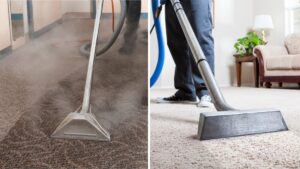
To be straight about our own service: professional hot water extraction isn’t the same as putting a steam mop on a urine spot. We pre-treat with enzyme product and let it work before any water goes down, and truck-mounted extraction pulls the water and dissolved residue back out rather than driving it deeper. Heat on untreated urine sets it. Heat after the proteins are broken down doesn’t. The order matters more than the equipment.
Vinegar. This contradicts most of what you’ll read. The Humane Society advises against ammonia and vinegar on pet urine because strong odors can encourage a pet to re-mark the spot — ammonia especially, since it’s a component of urine itself and reads to a dog as another animal’s marking. Vinegar will knock down a faint surface smell, but it doesn’t reach crystals in the backing and doesn’t break the compounds down the way enzymes do.
Baking soda alone. Absorbs surface odor. Does nothing at depth.
Masking sprays. Freshen the top while the source sits an inch below.
Scrubbing. Frays the fibers and spreads the contamination outward.
When to stop trying
Keep going yourself if it’s a fresh accident, a single spot, or a faint smell that doesn’t return.
Call someone if the smell returns whenever it’s humid, the same area has been hit repeatedly over months, you can smell it from across the room, or a ring reappears each time the carpet dries.
The pad may need replacing when urine has saturated it repeatedly. Nothing applied from above reaches a soaked pad, and even professional extraction has limits at that depth. In the worst cases it’s gone through to the subfloor, which needs sealing before new carpet goes down. Not pleasant to hear, but better than six months of buying products that were never going to reach it.
One thing worth knowing if you do replace: untreated subfloor keeps the pheromones, and a pet will return to the same spot on the new carpet.
Frequently Asked Questions
Why does my carpet smell like urine only when it’s humid?
Dried urine leaves crystals that absorb moisture from the air. When humidity rises they partly dissolve and the odor reactivates. It’s the clearest sign the contamination is in the backing or pad rather than on the surface.
Does professional carpet cleaning remove pet odor?
Depends how deep it went. Surface and backing contamination usually responds well to enzyme pre-treatment plus hot water extraction. A saturated pad improves but may not fully resolve. An inspection is the only way to know which you have.
Can I use vinegar on pet urine?
We’d advise against it. The Humane Society warns that strong odors like vinegar and ammonia can encourage a pet to re-mark the area, and vinegar doesn’t break down the odor compounds the way an enzyme cleaner does.
Will a steam cleaner get rid of dog urine smell?
Not on its own, and heat on untreated urine makes it permanent. Professional cleaning works because enzyme pre-treatment comes first and extraction pulls residue back out.
How long does pet urine smell last in carpet?
Untreated, indefinitely. The crystals don’t break down on their own, which is why a spot from two years ago still activates on a humid day.
How do I find urine spots I can’t see?
A blacklight in a fully dark room. Most people find several they didn’t know about — which is usually why treating the one visible stain never solved it.
The Short Version
Pet urine smell returns on humid days because dried crystals pull moisture from the air and reactivate. That’s depth, not cleaning.
Blot fast, saturate with enzyme cleaner and let it dry naturally, skip the vinegar, keep heat off untreated spots. If it comes back every time it’s muggy, it’s below where you can reach.
Budget Steemer handles pet odor across Orlando and Winter Garden with enzyme pre-treatment and truck-mounted hot water extraction. We’ll tell you honestly if the pad needs replacing rather than selling you a cleaning that won’t fix it.
Call (407) 541-7236 or request a free estimate.
Related: cleaning carpet without a machine ·how long carpet takes to dry in Orlando ·what carpet cleaning costs